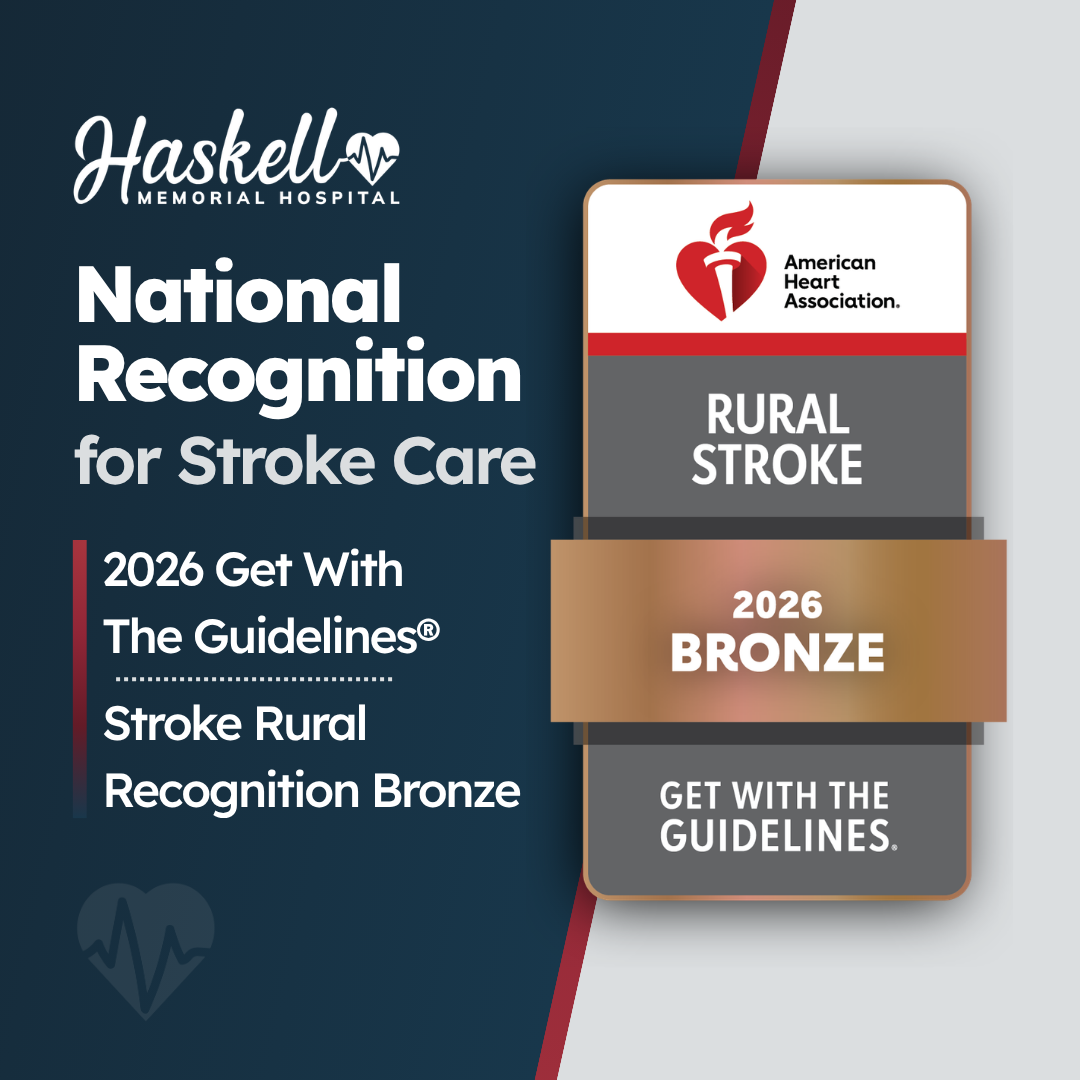
Hospital receives its first American Heart Association Get With The Guidelines–Stroke Rural Recognition award
Haskell Memorial Hospital has received the American Heart Association’s 2026 Get With The Guidelines–Stroke Rural Recognition Bronze award for its commitment to delivering timely, high-quality, evidence-based stroke care.
This marks the first time Haskell Memorial Hospital has earned the national recognition. The award is based on the hospital’s Get With The Guidelines performance data from October 1 through December 31, 2025.
The Bronze level recognizes hospitals that meet the program’s required performance measures for at least 90 consecutive days. Silver and Gold recognize those same measures sustained over longer periods, making this award an important first milestone in Haskell Memorial Hospital’s continued stroke care improvement efforts.“Receiving this recognition for the first time is an important milestone for Haskell Memorial Hospital and a reflection of the work our team does every day,” Michelle Stevens, MHA, CRHCP, CEO of Haskell Memorial Hospital. “When someone experiences a stroke, every minute matters. Our patients and families deserve access to high-quality emergency care close to home, and this award demonstrates our continued commitment to providing it.”
Stroke is the fourth highest cause of death and a leading cause of disability in the U.S., according to the American Heart Association’s 2026 Heart Disease and Stroke Statistics Report. A stroke occurs when a blood vessel supplying the brain is blocked by a clot or ruptures, preventing blood and oxygen from reaching brain tissue. Early detection and rapid treatment can improve survival, reduce disability, and support recovery.
The American Heart Association created its rural stroke recognition program to acknowledge the important role rural hospitals play in initiating timely, evidence-based stroke care. Hospitals participating in Get With The Guidelines–Stroke are evaluated using performance measures designed to address the distinct needs and challenges of rural communities.
“This award represents preparation, teamwork, and a shared commitment to following proven stroke care protocols,” said Meghan Shelton, BSN, RN, chief nursing officer of Haskell Memorial Hospital. “From recognizing symptoms and completing assessments to coordinating imaging, specialist consultation, treatment, and transfer when needed, our team understands the importance of acting quickly. I am proud of the clinical staff members whose dedication made this achievement possible.”
The Get With The Guidelines–Stroke Rural Recognition award recognizes hospitals for performance on guideline-directed measures that may include intravenous thrombolytic therapy, timely interfacility transfer, dysphagia screening, symptom timeline, and neurological deficit documentation, emergency medical services communication, brain imaging, and consultation with a stroke expert.
“We are proud that our team is being recognized for the important work we do to improve the lives of people throughout Haskell County and the surrounding region who are affected by stroke,” Stevens added. “Hospitals in communities like ours may face longer transportation distances and limited access to on-site specialists, but those challenges never compromise the standard of care our patients receive.”
“Patients and healthcare professionals in Haskell and the surrounding communities face unique health care challenges and opportunities,” said Karen E. Joynt Maddox, M.D., MPH, volunteer chair of the American Heart Association Quality Oversight Committee and co-author of the Association’s advisory on rural health. “Haskell Memorial Hospital has advanced the important work of improving care for all Americans, regardless of where they live.”
Community members should call 911 immediately when signs of a stroke appear. The American Heart Association recommends remembering the acronym F.A.S.T.: face drooping, arm weakness, speech difficulty, and time to call 911.